Ukraine Needs a Hi-tech Triad to Counter Russia's Nuclear Power
Smaller countries can resist larger invaders thanks to the latest technologies.
The Gaze reports on it according to Dzerkalo tyzhnia.
High-precision ammunition, electronic warfare systems, drones of various classes, autonomous systems, and long-range platforms have become the new basis for warfare using artificial intelligence. Full-scale war has shown that without numerical and nuclear superiority, it is only possible to inflict significant losses on a stronger aggressor through a developed technological ecosystem and willpower, writes Valery Borovik, chairman of the board of the New Energy of Ukraine Alliance, founder of the defence products manufacturer FIRST CONTACT, combatant, and commander of a special strike drone unit (2022–2024), in his article ‘Changing the paradigm of war: hi-tech triad versus nuclear’.
In his opinion, combined technologies make it possible to strike strategic Russian targets, and thanks to them, Ukraine demonstrates the possibility of asymmetric influence on targets that until recently were considered unattainable for states without strategic weapons. He mentioned Operation Spider Web, when SBU drones struck Russian strategic bombers deep behind enemy lines. According to the former military officer, the operation opened up a new type of warfare involving ‘the use of a large number of low-power strike elements against the enemy's vastly superior high-power strike components.’
"This was achieved thanks to the long and painstaking work of technical specialists, manufacturers, instructors, pilots, and representatives of special services, who directly planned and implemented complex elements of the operation at the final stage — both in Ukraine and abroad. This experience marked the beginning of the implementation of a new strategy of warfare against a significantly superior enemy, not only at sea but also on land," he writes.
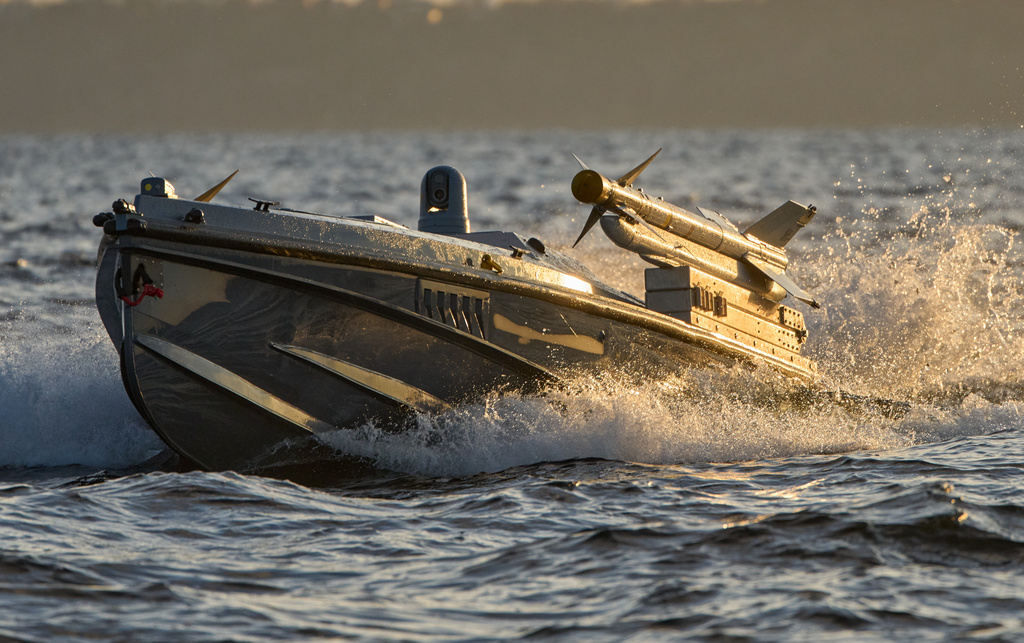
According to Borovyk, Ukraine's achievements in the field of UAVs, marine drones and the future ‘explosive development of ground-based robotic complexes’ should create a new technological ‘hi-tech triad’ that will counter nuclear weapons (strategic aviation, intercontinental ballistic missiles and nuclear submarine missile carriers).
Borovyk writes that in the new reality, smaller states can survive and resist larger invaders thanks to the latest technologies. According to him, this does not always require nuclear weapons, but it does require the ability to neutralise the means of their delivery.
"Various elements of the future “technological triad” of air, land, sea (surface or underwater) bases, as well as underground bases (as strange or unrealistic as it may sound today) can be used to accomplish this task. This can be done using only one of the elements of the triad that we have implemented earlier, or in combination, involving all means, in close coordination of each component," the author noted.
According to the former military officer, although operations such as ‘Pavutina’ are difficult to scale, technological solutions can be unified so that they can be used in other operations. He says Ukraine should create a powerful ‘hi-tech triad’ (a ‘high-tech triad’), which will also include underwater drones and, in the near future, space combat and reconnaissance unmanned aerial vehicles. He adds that active work is already underway in this direction.
"The next decisions on minimising size, actively using swarm technologies and artificial intelligence for planning and decision-making will make it possible to attack the enemy by surprise at virtually any point in their lair. This will create conditions for “a thousand wasp stings”, which can not only lead to the destruction of the enemy's defence systems and casualties, but also become one of the key elements of their downfall," Borovyk emphasised.
Just to recap, on 15 December, SBU drones attacked a submarine in Russia's main Black Sea port of Novorossiysk.
As the Gaze reported earlier Record-Breaking Ukrainian Interceptor Drone Outpaces F1 Cars.