Russia’s Nuclear Icebreakers Operate at Full Capacity to Support Energy Shipments
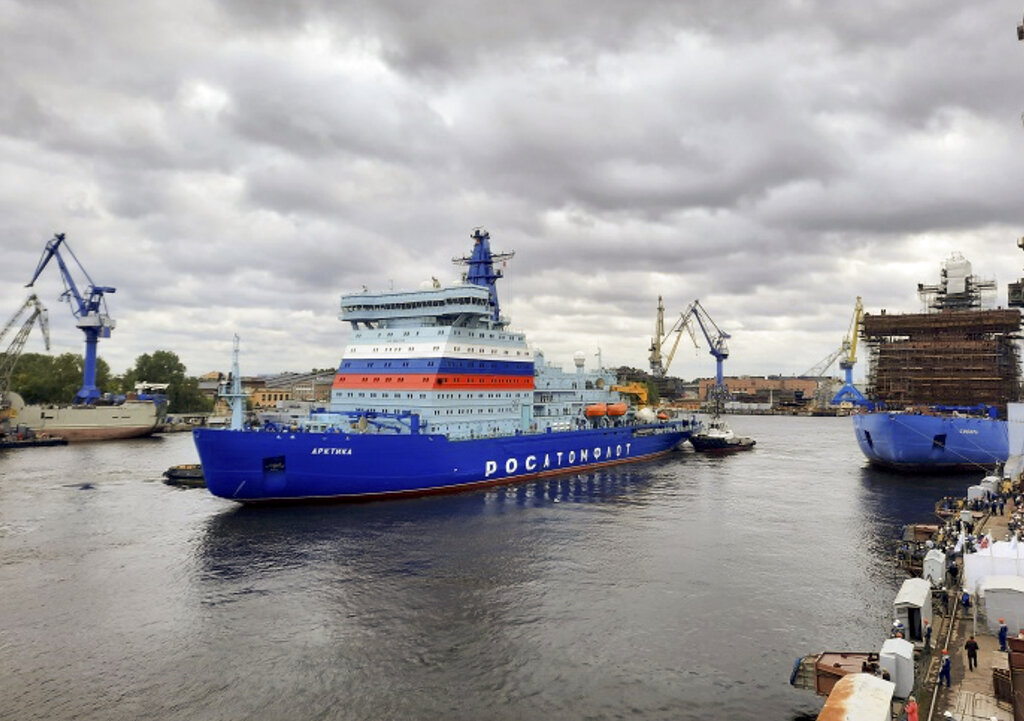
Russia has, for the first time, deployed its entire fleet of nuclear-powered icebreakers in the Arctic to ensure the Northern Sea Route remains navigable and to support energy exports amid sanctions.
The Gaze reports on it, referring to The Telegraph.
Moscow deployed all eight of its nuclear icebreakers, including four state-of-the-art vessels of Project 22220 (Arktika, Sibir, Ural, and Yakutia), two older giants of the Arktika class (Yamal and 50 Let Pobedy) and two shallow-draft “Taymir” class icebreakers.
They are clearing paths for tankers transporting oil, liquefied gas, and minerals from remote Siberian terminals, overcoming dense ice in the Ob Bay and Yenisei Gulf.
The nuclear icebreaker fleet allows Russia to keep the Northern Sea Route open almost year-round, reducing transit times to Asia and bypassing bottlenecks like the Suez Canal.
This makes Arctic projects a key source of revenue for the Kremlin’s economy, with cargo shipments expected to rise by 20% in 2025 due to new LNG terminals.
At the same time, operating all nuclear icebreakers at full capacity entails high maintenance costs and potential risks for the fleet’s future availability, highlighting the pressure on the Russian economy to maintain strategic transport routes amid sanctions and restrictions.
Russia has radically changed its policy in the Arctic, shifting its focus from economic ambitions to military domination, especially after the start of the full-scale war against Ukraine.
Until 2022, Russia's Arctic policy was based on economic and geopolitical documents such as the 2008 Arctic Strategy and the 2020 Arctic Policy. The main priorities were the extraction of oil, gas, rare earth metals, and the development of the Northern Sea Route.
After the start of the full-scale invasion of Ukraine, Russia's policy underwent three key changes.
First, sanctions significantly affected the Arctic energy sector, forcing Russia to seek new partners in China. Second, NATO's expansion in the north, particularly the accession of Finland and Sweden, has forced Moscow to strengthen its military presence in the region, conduct large-scale exercises, and deploy new Arctic military units. Third, Russia has stepped up cooperation with China under the Polar Silk Road initiative, which allows it to maintain Arctic infrastructure and transport corridors despite the reduction in Western shipping operations.
European states are actively monitoring and responding to the growth of Russian and Chinese military and intelligence activity in the Arctic. Earlier, Canada reported a significant increase in intelligence operations by both countries, targeting both state institutions and the strategically important private sector. In response to these threats, Canada is increasing investment in northern infrastructure and defense, including new icebreakers and the possible acquisition of patrol submarines.
Germany, for its part, is responding to Russia's militarization of the region by sending patrol ships to the Arctic and North Atlantic and participating in multinational exercises led by Canada (Operation Nanook).
As The Gaze reported earlier, the United Kingdom and Norway have begun discussions on a defence deal aimed at strengthening security in the Arctic and deterring threats from Russia