Why the Council of Europe Is Central to Holding Russia Accountable
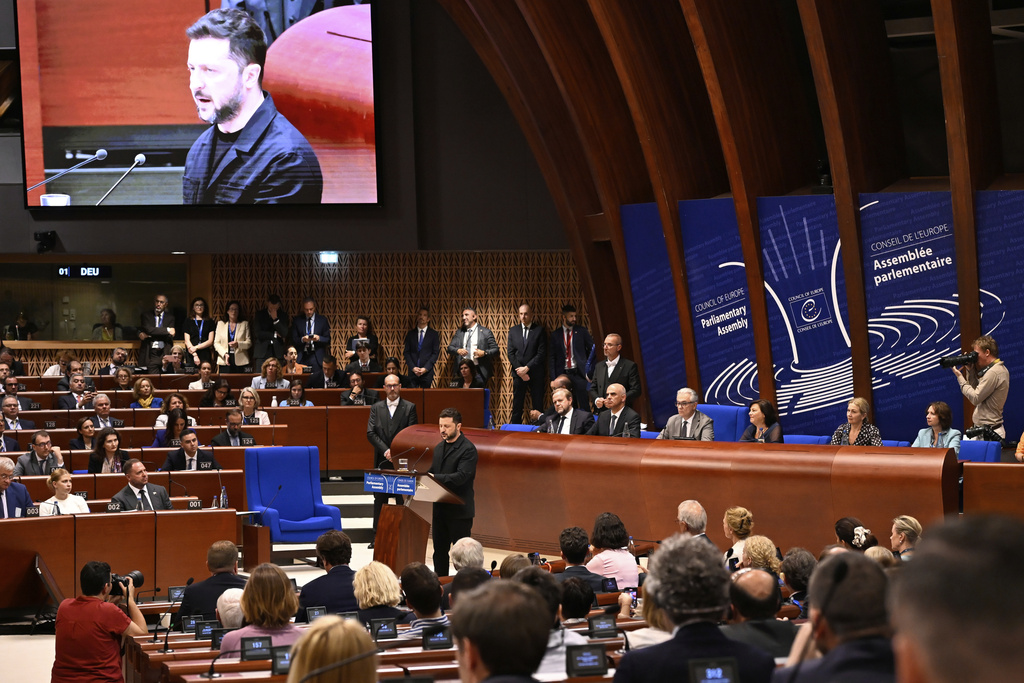
The Council of Europe plays a key role in shaping international legal mechanisms aimed at holding Russia accountable for its aggression against Ukraine. It is under the Council’s auspices that a comprehensive system for compensating war damages is currently being developed.
The Gaze reports on it, referring to an interview by Ukrinform.
As explained by Mykola Tochytskyi, Permanent Representative of Ukraine to the Council of Europe, the compensation mechanism consists of three elements.
The first is the Register of Damage, which records claims submitted by individuals and the state regarding losses caused by the war. The second stage is the International Claims Commission, the decision to establish which was adopted at a high-level diplomatic conference in The Hague. This body will review claims and determine the amount of compensation. The third element will be a compensation fund from which payments will be made.
The Council of Europe acts not only as a political platform but also as the main legal architect of this process. Within its framework, the legal foundations, procedures, and institutional logic are being developed, which will later be implemented in the Netherlands, where the relevant bodies will be based.
According to Tochytskyi, the creation of such a compensation commission is a unique step, as no comparable mechanisms exist in contemporary international law.
"There are no precedents for the creation of such a compensation commission in modern history. What the Council of Europe is doing now is a unique approach," he said.
Another major area of the Council of Europe’s work is the preparation of a Special Tribunal for the crime of aggression against Ukraine. The process of establishing an Enlarged Partial Agreement is currently underway, which will allow for the creation of the tribunal’s governing committee.
Both European and non-European states may join this agreement. According to the diplomat, several countries have already expressed their readiness to participate once the process is formally launched.
"We also need to have up to twenty-five countries, and it is desirable that there be large countries, including the one we are in — France, as well as Italy, Germany, and Great Britain," Tochynskyi noted.
The Council of Europe is also actively engaged in humanitarian and information-related efforts. This includes coordinating international work on the return of Ukrainian children illegally deported by Russia, countering disinformation, and supporting cultural diplomacy.
Through cultural projects, public discussions, and communication initiatives, Ukraine’s representation seeks to explain to European audiences the causes of Russia’s aggression and the threat it poses not only to Ukraine but to Europe as a whole.
According to Mykola Tochytskyi, Ukraine now has full international subjectivity, and the issue of Russian aggression is constantly on the agenda of the Council of Europe.
"It is important now that there are no meetings in the Council of Europe where Ukraine is not on the agenda. There is no committee where this agenda is not on the table," the diplomat emphasized. "So, in fact, right now, you could say that in the Council of Europe, the world revolves around us. It's about subjectivity."
At a time when other international institutions are often constrained in their ability to act, the Council of Europe remains one of the few platforms where the principles of international law are not only reaffirmed but translated into concrete action.
On December 16, at a high-level diplomatic conference in The Hague the Convention establishing the International Claims Commission was signed. The Commission will review claims recorded in the Register of Damage (currently over 85,000), determine compensation amounts, and disburse payments to Ukrainian citizens through a dedicated fund.
As The Gaze reported earlier, the European Union has warned Donald Trump that any attempts to pardon Vladimir Putin for war crimes in Ukraine would be a “historic mistake of huge proportions.”