Lockheed Martin to Forge NASA Nuclear Engine for Martian Expeditions
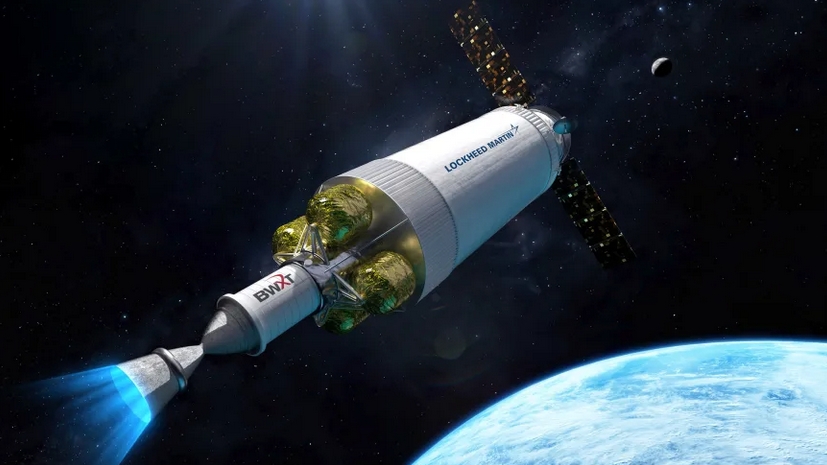
The US space agency NASA has announced a partnership with the Department of Defense to conduct space tests of a nuclear engine by 2027. The power plant will be developed by Lockheed Martin, with NASA investing $300 million in the project, as reported by Engadget.
The fundamental idea behind the nuclear engine is straightforward: a nuclear reactor heats up the fuel, likely liquid hydrogen, which expands and creates thrust as it passes through a nozzle. Nuclear thermal rockets can be three or more times more efficient than conventional chemical rockets.
The envisioned use of the nuclear thermal rocket aims to reduce flight duration, a crucial aspect of manned missions to Mars, as longer flights require more provisions and more reliable systems. Moreover, it would increase the payload capacity for scientific research and provide higher power for instruments and communication.
In 2020, the Defense Advanced Research Projects Agency (DARPA) stated its plan to test a flying nuclear thermal propulsion system, initiating the Demonstration Rocket for Agile Cislunar Operations (DRACO) project. Subsequently, NASA joined in developing a similar technology, although the military was interested in transporting payloads around Earth and the Moon, while NASA intended to utilize the nuclear engine for Mars exploration.
On Wednesday, NASA and DARPA announced their selection of Lockheed Martin to create an experimental spacecraft with a nuclear thermal reactor (X-NTRV). BWX Technologies will be one of the company's partners, responsible for the nuclear reactor's development and the production of high-quality low-enriched uranium fuel. The entire project, according to DARPA program manager Tabitha Dodson, will cost $499 million.
NASA will take the lead role in nuclear engine development, while DARPA will control various other aspects, including nuclear regulatory requirements, mission operations, and vehicle safety analyses. The nuclear reactor will be activated in a "cold" mode for safety reasons and will not be turned on until it reaches a sufficiently high orbit (likely between 700 to 2000 km above the Earth's surface).
Dodson explains that the spacecraft with the nuclear engine will be placed in the payload fairing of the Falcon 9 or Vulcan rockets and will look similar to the upper stage of a regular rocket. It will consist of a large hydrogen fuel tank, a nuclear reactor, the spacecraft's structural support, and a nozzle. Once the vehicle reaches a safe orbit, the reactor will be activated, rapidly heating the liquid hydrogen from -253 to +2427 degrees Celsius in less than a second.
"It is crucial to remember that this is a demonstrative technology. And, as with any other rocket engine test, NASA will likely have to conduct a series of further engine development works to approach an ideal working system," says Dodson.
The experiment is significant not only in testing the nuclear engine but also in using hydrogen fuel in space transportation. Until now, liquid hydrogen could be stored in space for only a few days since it boils at temperatures above -253 degrees Celsius. The mission will attempt to store liquid hydrogen in an ultra-cold state for several months, which would be sufficient for multiple tests of the nuclear thermal engine. Developers are also considering the possibility of spacecraft refueling by a space robot.