Moscow Weaponizes Religion as Over 700 Sacred Sites Are Hit
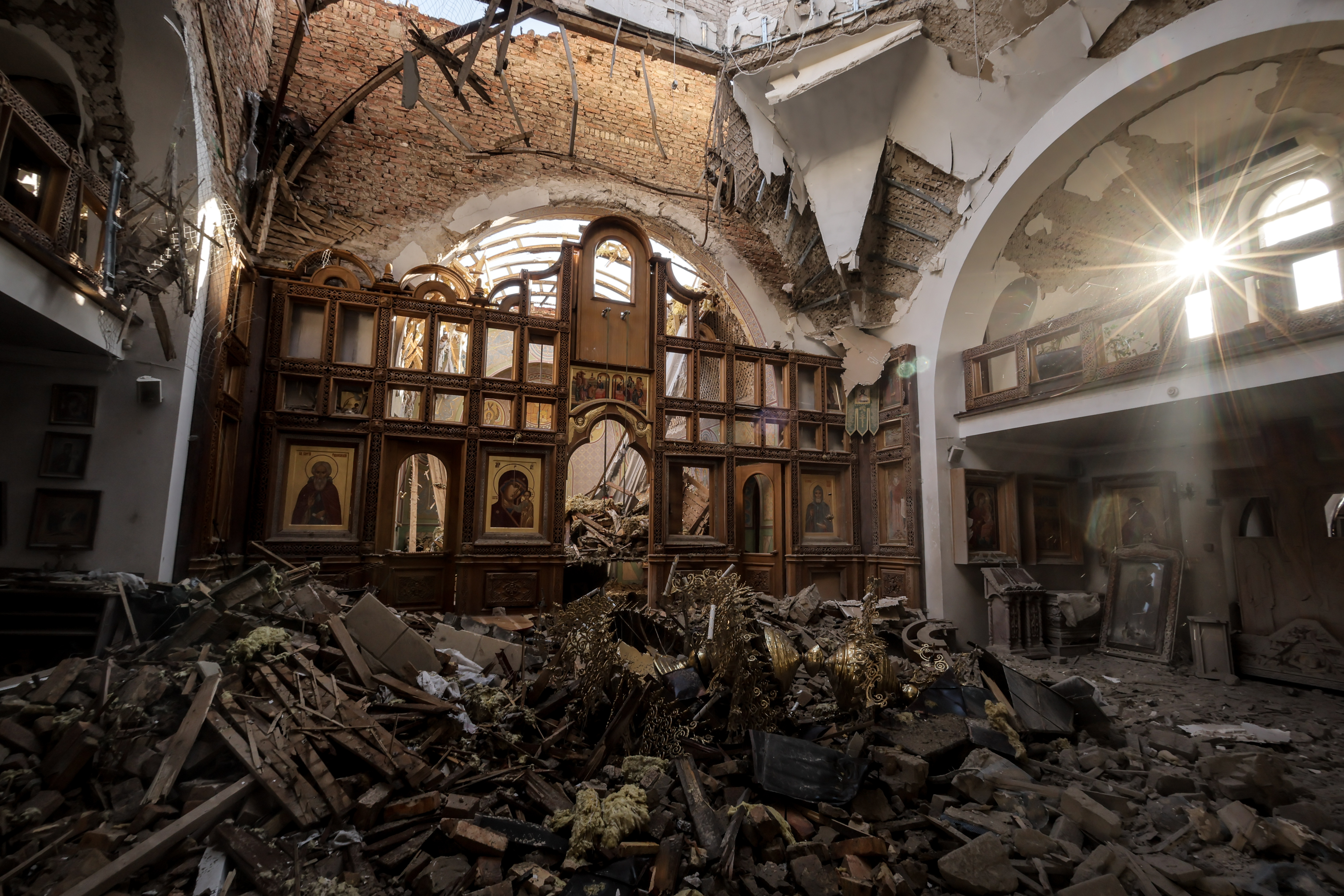
Russian aggression has inflicted large-scale damage on Ukraine’s spiritual space, destroying or damaging more than 700 religious sites.
The Gaze reports on it, referring to Interfax-Ukraine.
In an interview, Deputy Head of the Office of the President Olena Kovalska said that as of the end of 2025, 704 religious sites of various denominations had been destroyed or damaged as a result of the full-scale war, including churches, prayer houses, mosques, synagogues, and other places of worship.
A significant number of them were subjected to deliberate shelling and desecration, especially during the occupation of parts of Kyiv and Chernihiv regions in the spring of 2022.
“About 200 churches and prayer houses have been completely destroyed and must be rebuilt from scratch. Among them are historical and architectural monuments, including wooden structures that burned down as a result of artillery strikes,” she noted.
The restoration of religious sites is proceeding gradually and in different ways. Some churches are being rebuilt with the support of benefactors and religious communities from abroad, while others are being repaired with the involvement of local authorities. At the same time, a large number of destroyed shrines are located in frontline areas, where any restoration work is currently impossible.
Against the backdrop of this destruction, Russia and actors affiliated with it are trying to promote abroad, particularly in the United States, a narrative alleging persecution of the Ukrainian Orthodox Church (UOC) of the Moscow Patriarchate. Ukraine, however, insists that it acts as a democratic state strictly within the framework of the law, and that the decisions taken do not concern freedom of religion, the language of worship, or internal religious practices.
“The state has not closed a single church and will not do so in the near future. What is at issue is that the UOC must renounce its status of being affiliated with the aggressor state,” the Deputy Head of the Office of the President emphasized.
The key issue is not banning a church, but preventing institutional dependence of religious organizations on the aggressor state.
“Think for yourselves: we shut down businesses, we shut down organizations, we impose sanctions on those who have any ties to the aggressor state. Here the approach is the same as with business or anyone else — you must not be connected to the aggressor state,” she added.
The State Service of Ukraine for Ethnopolitics and Freedom of Conscience has officially proposed some concrete legal steps to the leadership of the UOC for withdrawing from the Russian Orthodox Church (ROC), without imposing any requirements regarding autocephaly, the calendar, or the language of worship.
Thus, claims about the persecution of religious freedom in Ukraine are an element of an information campaign orchestrated in Moscow. Ukraine does not ban faith and does not persecute believers; rather, it seeks to separate religion from the influence of the aggressor state.
“Therefore, no one has been persecuted. And what is happening in the United States is the same kind of staged performance as ‘Swan Lake’ in Rome. These are elements of the same calendar produced in Moscow,” Kovalska concluded.
Russia has a long practise of using religion to spread its propaganda around the world. Earlier, Ukrainian civil society representatives in Washington have raised concerns over a coordinated Russian disinformation effort targeting US lawmakers under the guise of religious advocacy. While identifying themselves as Ukrainians, they were allegedly advancing narratives closely aligned with Russian state propaganda.
As The Gaze previously reported, the Russian Orthodox Church actively promotes narratives aimed at undermining European political stability and societal cohesion. Notably, the ROC institutions are often positioned near European critical infrastructure, including military sites, bridges, airports, and nuclear facilities, sometimes in coordination with the state corporation Rosatom.
Read more on The Gaze: How Russia Twists Religion to Justify War: The Fake Narrative of Persecution in Ukraine